

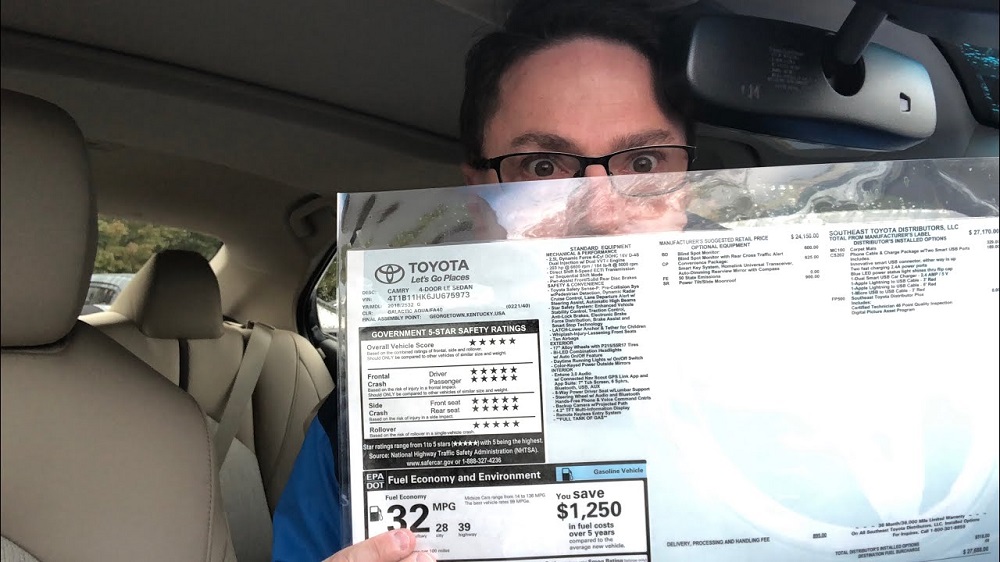
Buying a new vehicle is one of the largest financial decisions a consumer makes. When walking onto a dealership lot, the most prominent document attached to every new vehicle is the Monroney sticker, commonly known as the window sticker. Named after Senator Mike Monroney, who sponsored the Automobile Information Disclosure Act of 1958, this document is legally required on all new automobiles sold in the United States.
While most shoppers immediately lock onto the headline Manufacturer’s Suggested Retail Price, or MSRP, that bold number at the bottom represents only a small portion of the story. The window sticker contains a comprehensive layout of manufacturing specifications, financial breakdowns, fuel efficiency metrics, safety ratings, and dealer add-ons. Learning how to read beyond the sticker price empowers buyers to evaluate true vehicle value, avoid hidden costs, and negotiate from a position of confidence.
Understanding the Base Price versus Option Pricing
A common mistake car buyers make is confusing a vehicle’s base price with its final total price. The window sticker separates these figures clearly, usually positioned in the top or upper-left section of the document.
Decoding this section involves examining three distinct pricing tiers:
-
Standard Equipment: This section lists every feature, mechanical component, interior amenity, and safety technology included in the base price of that specific trim level. Carefully reading this section reveals whether a feature is built into the base package or added as a paid extra.
-
Optional Equipment and Packages: Located near the center or right column, this itemized list shows all factory-installed upgrades added to that specific unit. Options can range from individual features like upgraded paint or all-weather floor mats to expensive multi-feature packages containing advanced driver-assistance tech or premium audio systems.
-
Total Options Value: This subtotal sums up all factory-installed optional additions. Comparing this figure against the base price highlights how much extra money goes toward factory add-ons versus core vehicle mechanics.
Analyzing the optional equipment list allows shoppers to determine whether they are paying for features they actually want or paying extra for dealer inventory packed with unwanted accessories.
Navigating Destination Charges and Mandatory Fees
Directly below the options subtotal, buyers will find a non-negotiable line item listed as the destination charge or freight fee. This fee covers the transportation cost of shipping the vehicle from the assembly plant to the dealership, whether that journey originates across the state or across the ocean.
Understanding destination fees requires keeping a few key facts in mind:
-
Flat-Rate Pricing: Federal law requires automakers to charge a uniform destination fee for a specific model across all forty-eight contiguous states, regardless of how close or far the dealership is from the factory.
-
Non-Negotiable Factory Cost: Because the automaker charges this fee directly to the dealer, sales managers will rarely remove or discount the destination charge itself. However, knowing this fee helps separate legitimate factory charges from redundant dealer-added delivery fees.
-
Excluded from Base MSRP: Advertisements frequently highlight base prices that omit the destination charge. Factoring in this mandatory fee upfront prevents unexpected price jumps on the final quote sheet.
Uncovering Dealer Add-Ons and Addendum Stickers
The original Monroney sticker reflects only what happened at the manufacturing factory. However, dealerships often place a secondary document—known as a dealer addendum or market adjustment sticker—right beside the official factory window sticker. This secondary document is where extra costs frequently hide.
Common elements found on dealer addendums include:
-
Dealer-Installed Accessories: Items such as door edge guards, window tint, fabric protection, nitrogen-filled tires, or wheel locks. These items are marked up significantly above their actual cost.
-
Market Adjustments: Also labeled as additional dealer markup, or ADM, this line item represents an artificial price increase applied during periods of high demand or low inventory.
-
Administrative or Protection Packages: Vague line items bundled together under titles like Protection Package or Dealer Prep Fee.
Unlike the factory Monroney sticker, every line item on a dealer addendum sticker is open to negotiation. Buyers can explicitly request the removal of non-essential dealer accessories or insist that market adjustments be removed entirely before agreeing to a purchase.
Decoding Fuel Economy and Environmental Metrics
The Environmental Protection Agency, or EPA, panel occupies a substantial portion of every modern window sticker. This box provides critical long-term ownership cost data beyond the initial purchase price.
Key figures in the EPA section include:
-
Combined MPG Rating: Prominently displayed in large font, this number represents a weighted average of city and highway driving performance, calculated at forty-five percent highway and fifty-five percent city driving.
-
Annual Fuel Cost Estimate: Calculated based on an assumed fifteen thousand miles driven per year using current national average fuel prices. This metric makes it easy to compare running costs across different vehicle types.
-
Fuel Savings or Deficit Comparison: A box comparing estimated fuel costs for that specific vehicle against the average new vehicle over a five-year period.
-
Smog and Greenhouse Gas Ratings: Numerical scales ranking the vehicle’s environmental emissions against all other current models, with ten representing the cleanest score.
Evaluating this panel helps buyers calculate true cost of ownership, as a slightly cheaper vehicle with poor fuel economy can quickly become more expensive over years of daily commuting.
Evaluating Crash Test Scores and Safety Ratings
Safety data appears on the window sticker under the National Highway Traffic Safety Administration, or NHTSA, section. This panel presents crash test scores based on standardized evaluation programs.
When reviewing this section, pay close attention to:
-
Overall Vehicle Score: A consolidated star rating based on combined performance across frontal crash, side crash, and rollover evaluations.
-
Individual Crash Test Metrics: Separate ratings for front passenger safety, driver-side impact, and rollover resistance risk percentage.
-
Not Rated Designations: Newly released vehicle models or niche low-volume cars may display “Not Rated” simply because government agencies have not yet completed standardized testing.
Comparing star ratings across competing models provides objective proof of structural integrity and occupant protection capabilities.
Reviewing Parts Content and Assembly Information
Near the bottom corner of every Monroney sticker lies the parts content disclosure section, mandated by the American Automobile Labeling Act. This section details where the vehicle was built and where its primary components originated.
This section breaks down:
-
Final Assembly Point: The exact city and country where the vehicle was put together.
-
Percentage of US and Canadian Parts: Indicates the proportion of major components manufactured within North America.
-
Primary Foreign Component Sources: Identifies other nations supplying major assemblies, such as engines or transmissions.
For buyers interested in supporting domestic manufacturing or evaluating global supply chain origin, this section offers clear transparency into the physical manufacturing footprint of the automobile.
Frequently Asked Questions
Is a dealership legally allowed to remove a Monroney window sticker before a vehicle is sold?
No. Federal law prohibits removing, altering, or defacing a Monroney sticker before the vehicle is delivered to the ultimate retail buyer. If a new car on a dealer lot lacks a window sticker, buyers should request a printed copy before negotiating.
What is the difference between MSRP and the invoice price listed on a car?
MSRP represents the manufacturer’s suggested retail price for consumers. Invoice price refers to the initial amount the dealership paid the manufacturer for the vehicle, though dealer holdbacks, incentives, and volume bonuses usually reduce the dealer’s actual final cost below the invoice figure.
Are dealer-added accessories listed on an addendum sticker mandatory for the buyer?
No. Dealer-installed accessories are optional add-ons added by the dealership sales department, not the factory. Buyers can negotiate the price of these add-ons, ask for them to be removed, or refuse to pay for dealer markups entirely.
Why do some brand-new vehicles lack NHTSA star ratings on their window sticker?
When a newly redesigned vehicle enters the market, government testing agencies may not have acquired or crash-tested the vehicle yet. A lack of ratings does not mean the car is unsafe; it simply indicates that official government evaluation is still pending.
How are fuel economy figures calculated for electric and plug-in hybrid vehicles?
Electric vehicles use MPGe, or Miles Per Gallon Equivalent, a metric developed by the EPA to measure energy efficiency. It calculates how many miles an electric vehicle can travel on thirty-three point seven kilowatt-hours of electricity, which contains the energy equivalent of one gallon of gasoline.
Does the destination charge cover home delivery from the dealership?
No. The factory destination charge covers transportation from the assembly plant or import port to the dealership lot. If a customer requests home delivery from the dealership, the dealer may charge a separate delivery fee for that service.
Can a buyer keep the original window sticker after purchasing a new vehicle?
Yes. The window sticker belongs to the final retail customer once the purchase is completed. Buyers should keep the original Monroney sticker with their vehicle ownership records, as it provides a permanent record of factory options that can help preserve resale value down the road.
Comments are closed.